Nepal Tradition of Spot Between Eyebrows on Babies

A Nepali woman with a tilak on her forehead

A tilaka ceremony in progress to welcome the groom at a Hindu nuptials
In Dharmic culture, the tilaka (Sanskrit: तिलक) is a mark worn usually on the forehead, at the point of the Ajna chakra, or sometimes some other part of the body such equally the neck, hand, breast or arm. Tilaka may be worn daily or for rites of passage or special spiritual and religious occasions only, depending on regional customs.
The term also refers to the Hindu ritual of marking someone's brow with a fragrant paste, such equally of sandalwood or vermilion, as a welcome and an expression of accolade when they arrive.[1]
Historically, tilaka were too used in other Dharmic cultures including Buddhism, Jainism and Sikhism, which were influenced past Hinduism and its spiritual and philosophical beliefs.[ citation needed ]
Description [edit]
The tilaka is a marking created by the application of pulverisation or paste on the forehead. Tilakas are vertical markings worn by Vaishnavites (a sect of Hinduism) . The Vaishnava tilaka consists of a long vertical marking starting from merely below the hairline to virtually the terminate of one'due south nose tip, and they are also known as Urdhva Pundra.[ii] It is intercepted in the middle past an elongated U. There may exist 2 marks on the temples as well. This tilaka is traditionally fabricated with sandalwood paste.
The other major tilaka variant is often worn by the followers of Shiva, known by the names of Rudra-tilaka and Tripundra.[3] [4] It consists of three horizontal bands across the forehead with a single vertical band or circle in the centre. This is traditionally done with sacred ash from fire sacrifices. This variant is the more ancient of the two and shares many common aspects with similar markings worn across the world.

A Vaishnav Adult female wearing Tilak and distributing Spiritual Books.
Shaktas, worshippers of the various forms of the Goddess (Devi), wearable a big ruby-red dot of kumkum (vermillion or red turmeric) on the forehead.
Significance [edit]
Chapter 2 of the Kalagni Rudra Upanishad, a Shaiva traditional text, explains the three lines of a Tilaka as a reminder of various triads: three sacred fires, three syllables in Om, three gunas, three worlds, three types of atman (cocky), 3 powers in oneself, first iii Vedas, three times of extraction of the Vedic beverage Soma.[5] [6]
- The outset line is equated to Garhapatya (the sacred fire in a household kitchen), the A syllable of Om, the Rajas guna, the globe, the external cocky, Kriyā – the power of action, the Rigveda, the morning time extraction of Soma, and Maheshvara.[5] [6]
- The second streak of ash is a reminder of Dakshinagni (the holy fire lighted in the Due south for ancestors), the sound U of Om, Sattva guna, the atmosphere, the inner self, Iccha – the power of will, the Yajurveda, midday Soma extraction, and Sadashiva.[v] [half-dozen]
- The third streak is the Ahavaniya (the burn used for Homa), the Chiliad syllable in Om, the Tamas guna, Svarga – heaven, the Paramatman – the highest cocky (the ultimate reality of Brahman), Jnana – the power of knowledge, the Samaveda, Soma extraction at dusk, and Shiva.[v] [6]
These lines, stand for Shiva's threefold power of will (icchāśakti), knowledge (jñānaśakti), and action (kriyāśakti).[vii] The Tripuṇḍra described in this and other Shaiva texts also symbolises Shiva's trident (triśūla) and the divine triad of Brahmā, Vishnu, and Shiva.[7]
The Vasudeva Upanishad, a Vaishnava tradition text, similarly explains the significance of iii vertical lines in Urdhva Pundra Tilaka to be a reminder of Brahma, Vishnu, Shiva; the Vedic scriptures – Rigveda, Yajurveda and Samaveda; 3 worlds Bhu, Bhuva, Svar; the three syllables of Om – A, U, Yard; three states of consciousness – awake, dream sleep, deep sleep; three realities – Maya, Brahman and Atman; the three bodies – Sthula, Sukshma, and Karana.[viii] [9]
Traditions [edit]

Examples of Tilaks or sect-marking in British India, summarised by 19th-century scholar Russell
Different Hindu traditions utilise different materials and shapes to make the tilaka.[10]
- Saivites typically marker their Tilak using vibhuti (ash) in three horizontal lines across the forehead.[2] Forth with the three horizontal lines, a bindu of sandalwood paste or a dot of ruby-red kumkum in the middle completes the Tilaka (tripundra).[3] [xi]
- Vaishnavas apply a Tilak with vermillion, clay, sandalwood paste (Chandan), or latter two mixed.[ii] They use the material in two vertical lines, which may be continued at the bottom, forming a simple U shape, often with an additional vertical scarlet marking in the shape of a tulsi leaf inside the U shape. Their tilaka is chosen the Urdhva Pundra.[2] Encounter also Srivaishnava Urdhva Pundra, the Srivaishnava tilaka.
- Ganapatya use red sandal paste (rakta candana).[12]
- Shaktas employ kumkuma, or powdered cherry-red turmeric. They draw one vertical line or dot (not to be dislocated with Bindi used by Indian women from different religions).
- Honourary tilakas (Raja tilaka and Vira tilaka are usually applied as a unmarried vertical ruddy line. Raja tilaka volition exist used while enthroning kings or inviting prominent personalities. Vira tilaka is used to bless victors or leaders after a war or a game.
Cultural tradition [edit]

Applying Tilaka on the brow of guests to welcome and honor is a cultural tradition in Republic of india and Nepal.[1]
- Jains use Tilaka to marking the forehead of Jaina images with sandalwood paste, during Puja ceremonies.[thirteen]
- Christians in India apply Tilaka both to mark special occasions and during their worship rites. Some Christian women in Southward India apply Tilak to their brow (just like some Muslim/Christian women across India clothing the Mangala sutra).
- Hindus use the Tilaka ceremony to welcome guests and show them honour and respect, simply this is not a very mutual practise.[1] It may too be used, for same reason, to mark idols at the outset of a Puja (worship), to mark a rock or tree before it is cutting or removed from its original place for artisan piece of work, or to mark a new piece of property.[i] [fourteen]
- Indian Parsis (Zoroastrians) too apply it during their union ceremonies.
Types [edit]
The selection of fashion is not mandated in Hindu texts, and it is left to the individual and the regional civilisation, leading to many versions. The known styles include[fifteen] Vijayshree – white tilaka urdhwapundra with a white line in the heart,[fifteen] founded by Swami Balanand of Jaipur; Bendi tilaka – white tilak urdhwapundra with a white round mark in the eye,[16] founded by Swami Ramprasad Acharya of Badasthan Ayodhya; and Chaturbhuji tilaka – white tilak urdhwapundra with the upper portion turned 90 degrees in the opposite direction, no shri in the centre, founded past Narayandasji of Bihar, ascetics of Swarg Dwar of Ayodhya follow it. Sharma has named additional styles as, Vallabh Sampraday Tilak, Sri Tilaka of Rewasa Gaddi, Ramacharandas Tilaka, Srijiwarama ka Tilaka, Sri Janakraja Kishori Sharan Rasik Aliji ka Tilaka, Sri Rupkalajee ka Tilaka, Rupsarasji ka Tilaka, Ramasakheeji ka Tilaka, Kamanendu Mani ka Tilaka, Karunasindhuji ka Tilaka, Swaminarayana Tilaka, Nimbarka ka Tilaka and Madhwa ka Tilaka.[17]
In other cultures [edit]
- Tilak In Jainism: A major Jain population put tilak on their brow and also Jain women put bindi on their forehead.
- Tilak In Sikhism: Sikh gurus are ofttimes depicted with a Tilak/dot on their brow as a mark of enlightenment.
-
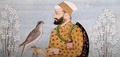
Guru Teg Bahadur Ji painting where he has Tilak on his forehead, Location: Lahore Museum, Islamic republic of pakistan
-

Guru Arjun Dev Ji's Tilak ceremony
-

Guru Nanak wearing Tilak, reference from 19th century Janam Sakhi, Guru Nanak meets the Vishnu devotee Praladh.

Visible Tilak in Buddha Statue
- In Buddhism: Putting tilak is non totally a Buddhist do during these days but a Tilak does have had a identify in Buddhist culture, and many statues of Buddha or related to Buddhism, and tilak tin be seen in major paintings and statues of Buddha. Buddhism take philosophies of Chakra that's why in that location is tilak to represent one of the chakras on statues or Paintings of Buddha.
Relationship to bindi [edit]
The terms tilaka and bindi overlap somewhat, merely are not synonymous.[18] Among the differences:
- A tilaka is e'er applied with paste or powder, whereas a bindi may be paste or gem.
- A tilaka is usually practical for religious or spiritual reasons, or to laurels a personage, event, or victory. A bindi tin signify marriage, or be just for decorative purposes.
A bindi is worn just between the eyes, whereas a tilaka tin likewise cover the face or other parts of the body. Tilaka tin be applied to twelve parts of the trunk: head, forehead, cervix, both upper-arms, both forearms, breast, both sides of the torso, tum and shoulder.
Terminology [edit]
It is as well chosen (তিলক) tilôk, (টিপ) tip or (ফোঁটা)phota in Bengali, tika, or tilakam or tilak in Hindi; Sanskrit: तिलक tilaka ; Hindustani pronunciation: [t̪ɪˈlək])[19]
In Nepal, Bihar, Uttar Pradesh, and other regions, the tilakam is called a tikā/teeka (टिका [ʈɪka]), and is a mixture of sindoor, a ruddy pulverisation, yoghurt, and grains of rice. The about common tilakas are red powder applied with the thumb, or sandalwood (chandan) paste, in a single upwards stroke.
Run across also [edit]
- Ash Wed – a forehead mark tradition in Christianity
- Bindi – a corrective item of ornamentation for women in South asia
- Fascinator – a cosmetic item worn near the brow, an culling to a lid
- Third eye
- Tilak (Vaishnava)
- Urdhva Pundra Tilak
- Vibhuti – Sacred ash made of burnt wood, burnt cow dung, or from the cremation of bodies.
References [edit]
- ^ a b c d Axel Michaels (2015), Homo Ritualis: Hindu Ritual and Its Significance for Ritual Theory, Oxford University Press, ISBN 978-0190262631, pp. 100-112, 327
- ^ a b c d James Lochtefeld (2002), "Urdhvapundra", The Illustrated Encyclopedia of Hinduism, Vol. ii: N–Z, Rosen Publishing, ISBN 978-0823931798, p. 724
- ^ a b Deussen 1997, pp. 789–790.
- ^ Klostermaier 1984, pp. 131, 371.
- ^ a b c d Deussen 1997, p. 790.
- ^ a b c d Nene 1999.
- ^ a b Antonio Rigopoulos (2013), Brill'southward Encyclopedia of Hinduism, Volume 5, Brill Academic, ISBN 978-9004178960, pp. 182-183
- ^ Sunder Hattangadi (2000), Vasudeva Upanishad, Sama Veda, SanskritDocuments Archives
- ^ D Dennis Hudson (2008), The Trunk of God, Oxford University Press, ISBN 978-0195369229, pp. 90-95
- ^ Makhan Jha, Anthropology of aboriginal Hindu kingdoms: a study in civilizational perspective, p. 126
- ^ Gautam Chatterjee (2003), Sacred Hindu Symbols, Abhinav Publications, ISBN 978-8170173977, pp. eleven, 42, 57-58
- ^ Grimes, John A. (1995). Ganapati: Song of the Self. Albany: Land University of New York Press. p. 202, note 40. ISBN0-7914-2440-five.
- ^ Robert Williams (1998), Jaina Yoga: A Survey of the Mediaeval Śrāvakācāras, Motilal Banarsidass, ISBN 978-8120807754, pp. 221-222
- ^ E. Washburn Hopkins (1910). "Mythological Aspects of Copse and Mountains in the Smashing Epic". Journal of the American Oriental Gild. xxx (4): 347–374. JSTOR 3087578.
- ^ a b Vijay Prakash Sharma, p. 72.
- ^ Vijay Prakash Sharma, p. 73.
- ^ Vijay Prakash Sharma, p. 75.
- ^ personal organized religion.[ total citation needed ]
- ^ V. S. Apte. A Practical Sanskrit Lexicon. p. 475.[ full citation needed ]
Bibliography [edit]
- Deussen, Paul (1997). Lx Upanishads of the Veda. Motilal Banarsidass. ISBN978-81-208-1467-7.
- Entwistle, A. W. (1981). Vaishnava tilakas: Sectarian marks worn by worshippers of Vishnu (IAVRI bulletin). International Association of the Vrindaban Research Plant.
- Klostermaier, Klaus K. (1984). Mythologies and Philosophies of Salvation in the Theistic Traditions of Bharat. Wilfrid Laurier Univ. Press. ISBN978-0-88920-158-3.
- Nene, Roopa (1999). "कालाग्निरुद्रोपनिषत् (Kalagnirudra Upanishad)" (PDF) (in Sanskrit). Retrieved 28 January 2016.
- Vijay Prakash Sharma. The sadhus and Indian civilisation. [ total citation needed ]
Further reading [edit]
- Mittal, Sushil; Thursby, Factor R. (2006). Religions of South asia: An Introduction. Taylor & Francis, United Kingdom. ISBN 0-415-22390-3. pp. 73.
External links [edit]
 | Wikimedia Commons has media related to Tilak. |
 | Wikiquote has quotations related to: Tilaka |
- How to put on Tilak, Hare Krishna Temple
- Tilaka : Hindu marks on the forehead, Priyabala Shah
Source: https://en.wikipedia.org/wiki/Tilaka

Post a Comment for "Nepal Tradition of Spot Between Eyebrows on Babies"